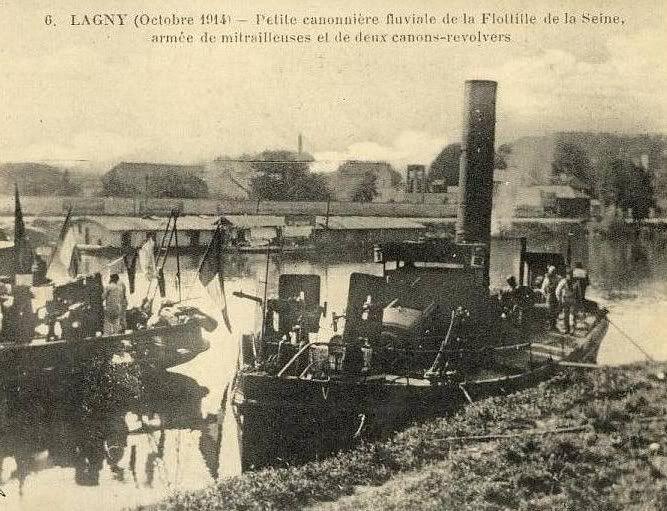
I found this picture last night and am very curious as to any modified river gunboats used by the French in WW1. I know about the canonnières fluviales built in Brest and Lorient with the 140mm and 100mm guns. This little boat looks very interesting.
The caption mentions "Canon-revolvers." would these be the 37mm or 47mm revolvers from the late 1800s?
Did boats like these see any combat?
Does anyone have any other phots or information on craft like these? [/img]
Hello Dave,
This postcard show two inland tugs armed at the begining of the war when German Army walked on Paris. This ships were acting on Seine and Marne but were not acting in gunfire because the Marne's battle stopped the german advance.
At the end of the year 1914, this flottilla was disabanded and the crew were transferred to the Brigades des Fusiliers Marins of rear admiral Ronarch' (frenchs marines brigad).
Yes, the caption mentions "Canon-revolvers." concern the 37mm or 47mm revolvers guns from the late 1800s which are obsolete on figthing ships.
Regards
Alain Croce
(Capu Rossu from Forum Südwall)
Hello Dave,
I found the passage that the captain Thomazi dedicates in this flotillas in his book " La Marine Française dans la Grande Guerre- Les Marins à terre (The French Navy in the Great War - The Sailors on the ground) " edited in 1933 by Payot (Paris)
Il faut dire un mot ici d’une formation qui n’eut à jouer aucun rôle, mais à laquelle la Marine consacra une partie de ses ressources : la Flottille de la Seine, crée à l’image de celle de 1870.
La constitution de cette flottille destinée à la seine, à l’Oise et à la Marne avait été décidée par le Ministre de la Marine le 2 août, mais interrompue le 1er septembre, la marche rapide de l’ennemi donnant à penser qu’on aurait pas le temps de réunir les bâtiments ; elle fut reprise le 6 septembre sur la demande du Gouverneur Militaire de Paris (général Gallieni). La flottille était prête à agir le 18 septembre.
Elle se composait de 11 remorqueurs de la Seine, baptisés canonnières et armés chacun d’un canon de 47 mm, de 3 ou 4 37, approvisionnés à 1000 coups par pièce. L’effectif comprenait 374 officiers mariniers, quartiers-maîtres et marins, un lieutenant de vaisseau ou enseigne pour commander chaque canonnière et un capitaine de frégate chef de la flottille.
En octobre, le gouverneur militaire demandait encore qu’on y ajoutât de nouveaux remorqueurs plus puissants, armés d’un canon de 100 mm mais la Marine fit observer que ces bâtiments auraient un trop important tirant d’eau pour pouvoir être utilisés en amont de Paris et la proposition n’eut pas de suite.
La flottille fut désarmée à la fin de décembre 1914 et son personnel réparti entre les autres formations militaires organisées par la Marine.
We must say a word here of training who had no role to play, but that the Navy spent a portion of its resources: the Flotilla of the Seine, creates the image of that of 1870.
The establishment of this fleet to the Seine, the Oise and the Marne had been decided by the Minister of the Navy on 2 August, but suspended on 1 September, brisk walking of the enemy suggesting that would have no time to bring the buildings, and was resumed on September 6 at the request of the Military Governor of Paris (General Gallieni). The fleet was ready to act on 18 September.
It consisted of 11 tugs of the Seine, known gunboats and armed each with a 47 mm gun, 3 or 4 37, supplied to 1000 strokes per gun. The number included 374 petty officers, leading seamen and sailors, a lieutenant commander or a sub lieutenant for each gunboat and a commander as leader of the flotilla.
In October, the Military Governor asked that it still ajoutât new more powerful tugs, armed with a 100mm gun but the Navy pointed out that these buildings would have too much draft to be used upstream of Paris and the proposal was not on.
The fleet was disarmed at the end of December 1914 and his staff distributed among the other military formations organized by the Navy.
 [/img]